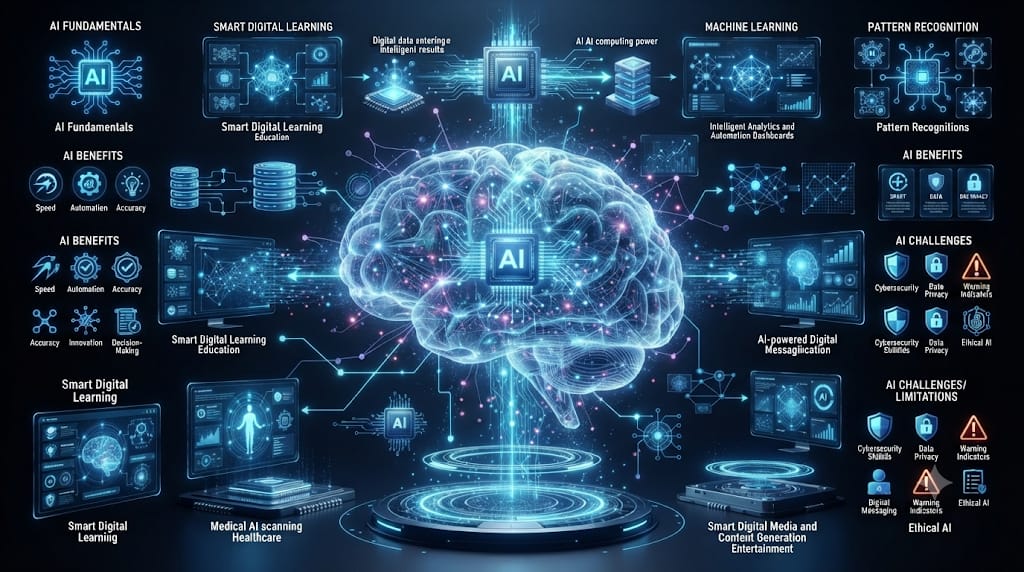
Artificial Intelligence, commonly known as AI, is one of the most important developments in modern technology. It is changing how people work, learn, communicate, and interact with digital systems.
From virtual assistants to recommendation systems, AI is becoming part of many everyday applications.
What Is Artificial Intelligence?
Artificial Intelligence is a field of computer science focused on developing systems that can perform tasks commonly associated with human intelligence.
These tasks may include recognizing patterns, understanding language, analyzing information, and generating responses.
AI systems use data, algorithms, and computational models to produce results.
How Does Artificial Intelligence Work?
AI systems generally work through several stages.
1. Data Collection
AI models use data to identify patterns and learn relationships. The quality and relevance of data can affect the usefulness of the results.
2. Training
During training, machine learning algorithms process examples and adjust their internal parameters to improve performance.
3. Pattern Recognition
AI systems can identify patterns in information such as text, images, audio, and numerical data.
4. Generating Results
After processing an input, an AI system produces an output based on its training and design.
Common Applications of AI
Artificial Intelligence is used in many areas.
Education: AI tools can support learning, explain concepts, and help organize study materials.
Healthcare: Certain AI systems assist professionals with image analysis, research, and administrative tasks.
Business: Organizations use AI for data analysis, customer support, and workflow automation.
Communication: Language technologies can support translation, transcription, and text generation.
Entertainment: Recommendation systems suggest music, videos, and other content based on user activity.
Benefits of Artificial Intelligence
AI can help automate repetitive tasks, process large amounts of information, and support faster analysis.
It can also make certain digital services more accessible and improve efficiency in different industries.
Challenges and Limitations of AI
Artificial Intelligence also has limitations. AI-generated information can be inaccurate, incomplete, or outdated.
Privacy, data protection, bias, transparency, and responsible use are important considerations when developing or using AI systems.
Users should verify important information instead of relying entirely on automated responses.
Conclusion
Artificial Intelligence is an evolving technology with applications across many industries. Understanding its basic concepts can help people make better use of modern digital tools.
Jedi Computing shares easy-to-understand technology information to help readers stay informed about the changing digital world.